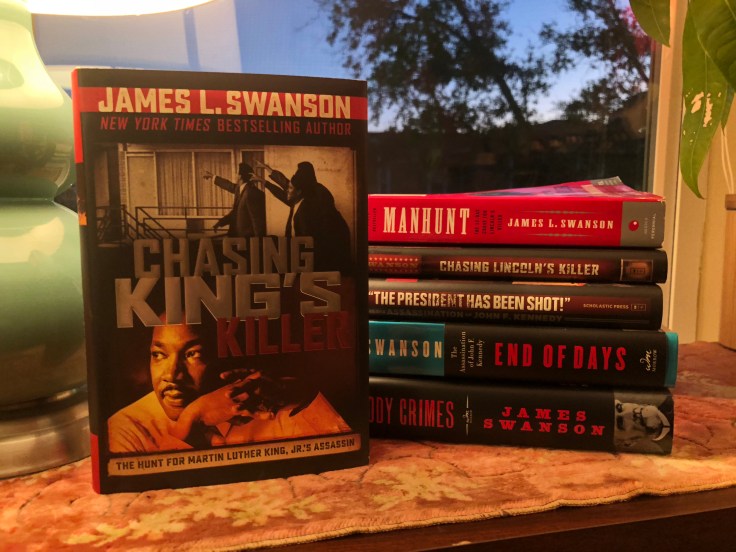
Several years back Manhunt by James Swanson captured my attention and it became one of the few books that I have reread multiple times. It even inspired me to go on my own journey into the Lincoln assassination by retracing Booth’s escape route.
Through the years, Swanson has published other works that have been equally as compelling, including adaptations for the children and young adult crowds. With the 50th anniversary of Martin Luther King’s assassination coming up in April, Swanson has released Chasing King’s Killer.
What I always enjoy about Swanson’s work is that he gives a good overview of the times. Rather than just jumping in, Swanson gives good context of the times before the event. In Chasing King’s Killer, background is given on the Jim Crow era that sets the stage nicely. In addition, the two central characters, Martin Luther King Jr. and James Early Ray are effectively fleshed out as two actual humans rather than just two historical figures.
Much like his previous work with Manhunt and others, Swanson forms the story into an almost theatrical experience, leaving the reader wanting more and hoping that the worst is not about to happen. When the tragic moment of King’s assassination arrives, it feels very personal due to Swanson’s gift of storytelling.
Although, the book is written for and geared for a younger crowd, it is definitely one of those books that would provide excellent background for adults too. Had he written for a largely adult audience, I would think that Swanson would have spent more time discussing the controversies regarding Ray as the killer. Like the Kennedy assassination, numerous conspiracy theories have been spun, many of them based on the fact that Ray changed his story multiple times and then died leaving unanswered questions.
As a teacher, I loved including books instead of textbooks to guide our learning. the richness in detail often led to better discussion not just on the actual events but branched out to other areas too. Chasing King’s Killer is another excellent addition to James Swanson’s any history lovers library.
 One if by Land Adventures
Leave a comment